
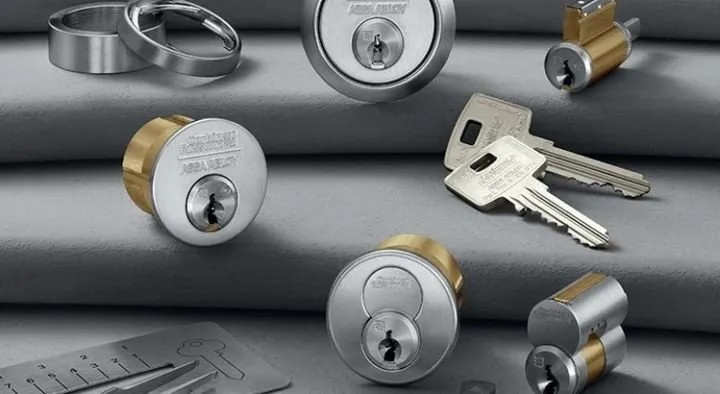




Stop the copy before it is cut.
Somewhere in most buildings there is a key stamped DO NOT DUPLICATE. Worth saying plainly what that stamp does: nothing. The blank it was cut from sits in a bin at any hardware counter, the machine is on the wall behind it, and the stamp relies on a stranger with no reason to honor it. You find out a copy exists when it opens a lock.
A restricted key system moves the control off the stamp and into the blank. The key profile is patent-protected, so the blanks are not sold openly and a counter machine has nothing to cut. Duplication then runs through authorization and a locksmith instead of through whoever holds the key: copies are ordered by the people you have named, and a key in a pocket is no longer permission to make another.
That changes how a key set behaves over time: it cannot quietly grow, so a staff change becomes a question of collecting keys rather than guessing how many exist. Scope runs from the few openings that matter (a stock room, a main entrance) to every exterior lock on a property. Where a building is already keyed to a plan, restricted cylinders come into it.
The limit is real: control over copies, not over keys. A restricted key can still be lent, lost or kept by someone who left, and the fix is the same as for any key: the cylinder is re-pinned and the old one stops working. Restriction also says nothing about what a lock withstands when it is attacked rather than copied. That is hardware.
Where we do this work
- Offices
- Storefronts
- Restaurants
- Apartment & condo properties
- Warehouses
- Medical facilities
- Multi-tenant buildings
What’s included
-
Restricted key systems set up from scratch
A controlled key profile put on the locks you choose, so the keys for those locks cannot be cut from an open blank.
-
Key control kept with ownership
Authority to order a copy sits with the owner or the management you designate, not with whoever is carrying the key.
-
Fewer unauthorized copies in circulation
The set of keys stops growing in the background, because growing it now takes a decision.
-
Keys issued and reissued as staff change
A program that stays organized through turnover instead of being rebuilt after it, with what was keyed to what written down and handed over.
-
Restricted keying across a whole property, or on selected locks
One room, one tenant’s suite or every exterior opening, to the same control.
-
Restricted keyways on high-security hardware
Medeco, Mul-T-Lock, Yale and other professional commercial systems bring the controlled profile and the hardened cylinder together.
Triggers
When you need to control the copies
Restricted keying is what a locksmith reaches for when the problem is not the lock, and not even who holds a key, but how many keys exist.
-
You have no idea how many copies of your key are out there
Nobody does, in a building where any key could be duplicated on the way home.
-
Staff or contractors keep turning up with their own keys
Convenient for them, and a quiet decision about your building that nobody authorized.
-
A key came back, and you do not believe it was the only one
Collecting a key proves one key was returned, and nothing else.
-
You are rekeying regularly and it keeps happening
Retiring old keys over and over is treating the symptom: the copies come back because the blank is still on sale.
FAQ
Key control, the questions we actually get.
Don’t see yours? Call (857) 327-1767
We already stamp our keys DO NOT DUPLICATE. Isn’t that enough?
No, and this is the thing worth being blunt about. The stamp has no mechanism behind it: it asks a counter clerk for a favor and relies on a stranger refusing business. A restricted system removes the choice from the clerk by not supplying the blank, which is the difference between a policy and a control.
Do restricted keys cost more?
Yes, per key and usually per cylinder, because you are paying for a controlled key profile rather than a commodity blank. The number is driven by the lock count and by whether your existing cylinders can take the restricted keyway or need changing, which is the part worth pricing before you commit. The scope and the price are quoted up front, with no hidden fees.
Can you put this on the locks we already have?
Sometimes. A restricted system lives in the keyway, so it usually means the cylinders change even where the lock bodies, levers and trim stay on the door. Where an existing cylinder can carry it, we work with what is there. Where it cannot, we will say which locks need new cylinders instead of promising a control the hardware cannot hold.
Once the system is in, how does somebody actually get another key?
Through the authority, not through the keyholder. The order comes from the people you name when the system is set up, ownership or the management you designate, and it is checked against that authorization before a locksmith cuts a key. There is no counter to go to either, because the blank is not sold openly, so a key in a pocket is a key to use and not permission to make another. What it asks of you is deciding who holds that authority at the outset, and keeping that decision current.
What happens when the person holding key authority leaves, or the business changes hands?
The authority sits with the role rather than with the person, so it moves when the role moves, and the real work is updating who holds it as soon as that happens. Leaving an old name in place cuts both ways: nobody still at the property can order a key, and somebody who has left still can. The hardware is unaffected either way, because the cylinders and the restriction stay with the building. If a handover leaves you unsure which keys are out there, the restricted cylinders can be rekeyed, which retires the old key set without giving up the control.
What happens if a restricted key is lost?
The restriction limits copies, so a lost key is one key rather than an unknown number, which is a materially better position than the same loss on an open keyway. It is still a key to that lock, though, so the answer is to rekey the cylinders it opened. The difference is that you can be reasonably confident about what you are retiring.
Can this be set up outside business hours?
Yes. We work 24/7 across Boston and the surrounding 30-mile area, so cylinders can be changed over on a weekend or overnight rather than while tenants and staff are trying to use the doors.
Emergency
Break-in, failed lock, or locked out?
When your property’s security is compromised, our emergency locksmiths respond immediately to repair locks, replace compromised cylinders, and restore reliable operation.
- Commercial Lockouts
- Break-In Lock Repairs
- Emergency Cylinder Replacements
- 24/7 After-Hours Response
Request a quote
Request a quote
Our client services team is standing by to assist with locksmith services, lock changes, high-security hardware, master key systems, lock repairs, rekeying, and emergency security dispatch!
- Hours
- Monday – Sunday: 24/7 Service
- Service area
- Boston and surrounding 30-mile radius
Fully insured by Hiscox
- Google rating
- Verified Screened professionals
- Hiscox Fully insured
- Transparent pricing No hidden fees