
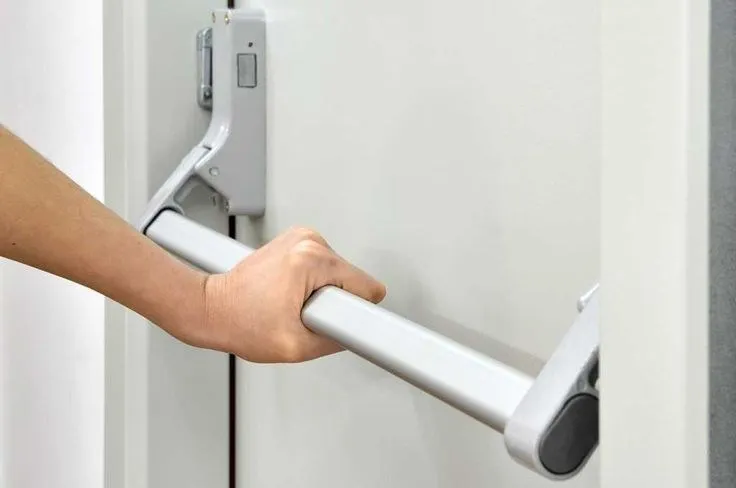




It has to open under a shove, first time, every time.
The test for a lock on an exit route has nothing to do with how it looks. Someone who has never used that exit, moving fast, maybe in the dark, pushes it and it opens. No key, no thumbturn, no thinking. That is the whole job of the exit lock, and a bar that has stopped doing it is worth knowing about before the day you need it.
A panic device turns a push anywhere along its width into a retracted latch, which is why it works when someone hits it with a hip or a shoulder. There is no handle to find and no direction to work out: the bar runs most of the width of the leaf, so contact anywhere on it is contact in the right place. Dogging holds that latch back, so an entrance is push-pull during business hours and locks again after.
We install these exit locks and service the ones already fitted. Which one fits depends on the opening and on whether it is a single leaf or a pair. Rim devices latch into a strike on the frame. Mortise devices work through a lock case in the edge of the leaf. Vertical rod devices, surface or concealed, latch top and bottom, which is what a pair without a center post needs. Scope runs from one opening to every exit lock on a property, where the hardest-used ones are already out of adjustment.
The calls are mechanical: a latch that no longer retracts fully, dogging that has stopped holding, a device loose on its mounting, a strike the latch cannot reach because the leaf has dropped. The last of those is not a device problem. A bar fighting a sagging leaf or a racked frame goes back out of adjustment however carefully it is set, so the honest fix is lock and frame repair, and we will say so rather than adjust the same device twice.
Where we do this work
- Offices
- Storefronts
- Restaurants
- Apartment & condo properties
- Warehouses
- Medical facilities
- Multi-tenant buildings
What’s included
-
Installation on exit doors
An exit lock chosen for the opening it is going on, and for whether that opening is a single leaf or a pair.
-
Service on devices already fitted
The exit lock you have now, checked and adjusted where a setting or a fixing is what has gone wrong.
-
Latch and strike
The latch brought back to full travel, and into a strike it can actually reach, so the exit locks when it closes.
-
Dogging
The hold-back set so the exit is push-pull when you want it that way and locking again when you do not.
-
Mountings and fixings
A device that has worked loose brought back onto a sound fixing, since movement at the mounting is what puts the latch out of line.
-
One exit or every exit on the property
A single opening, or a walk of all of them so no exit lock is the one nobody checked.
Triggers
When an exit device needs looking at
Whoever uses the exit every day usually notices all of these weeks before anyone calls a locksmith about them.
-
You push the bar and the door does not open
The latch is not coming back far enough, or it is coming back fine and no longer meeting the strike.
-
The exit stops staying unlatched during opening hours
Dogging that has stopped holding puts the lock back into play when you did not ask for it.
-
The bar moves or rattles when you push it
A device working loose on its mounting pulls itself further out of line every time somebody uses the exit.
-
The exit has to be lifted or pulled before it will lock
The leaf has dropped, and the latch is arriving somewhere the strike is not.
FAQ
Exit devices, the questions we actually get.
Don’t see yours? Call (857) 327-1767
Does an exit device get adjusted, or does it need a new one?
It depends on what has failed, and nobody can tell you from a description: a device loose on its mounting or out of line with its strike is labor on hardware you already own, while a worn or damaged one is a new exit lock fitted. Common exit hardware is the kind of part that is usually available, and less common devices, concealed vertical rod sets among them, are ordered in. When that happens, the exit is left opening from the inside the way it should and the opening made as secure as it can be without changing that, and the device is fitted on a second visit. We tell you which of those you are looking at, and agree the scope and price, before anything is ordered.
The bar pushes but the door does not open. What is happening?
Usually the latch is no longer retracting far enough, or it is retracting fine and the strike has moved, which is what happens as a leaf drops on its hinges over a few years. The two feel almost the same from the inside and they are different locksmith jobs. Where the same exit keeps costing you a call, replacing the component that keeps failing is often the cheaper end of it.
How do I tell which type of exit lock is on our door?
Usually without taking anything apart. If the latch comes out of the end of the device and catches a strike on the frame, it is a rim device; if it comes out of the edge of the leaf itself, there is a mortise lock case behind it. If rods run up to the head of the frame and down toward the floor, or the exit latches top and bottom with nothing visible, it is a vertical rod device, surface or concealed. Describe what you can see when you call and we will work from that.
What is dogging, and should our exit be dogged during business hours?
Dogging holds the latch retracted, so the exit behaves as push-pull and stops relocking every time it closes. Plenty of properties use it to make a busy entrance act like an ordinary opening while the business is open, then release it so the lock catches again at close. It is a setting on the device rather than a modification, and it is one of the first things to check when an exit that used to stay free has started catching.
How often should exit devices be checked?
Wear follows traffic rather than the calendar, but as general guidance most properties look at their locks once or twice a year, and more often on the openings that take the traffic. A back exit used twice a day and a main exit pushed hundreds of times are in completely different condition after a year, even with identical hardware, so the busy ones earn the extra look. The habit worth keeping in between is pushing each one from the inside the way somebody in a hurry would, and calling a locksmith when an exit does not open on the first push or does not lock behind you.
Can you go through every exit on the property, not just the one that failed?
Yes. Offices, storefronts, restaurants, warehouses, medical facilities and multi-tenant buildings usually have at least one exit nobody opens from one month to the next, and those are the exit locks that drift out of adjustment unnoticed. Walking all of them in one visit tends to find the one that would have been the next call, and you get the scope and the price before anything is touched.
Can a locksmith come after hours?
Yes. We work 24/7 across Boston and the surrounding 30-mile area. An exit that will not open from the inside, or one that will not lock when it closes, is not something to leave until the next business day, so call when you notice it.
Emergency
Break-in, failed lock, or locked out?
When your property’s security is compromised, our emergency locksmiths respond immediately to repair locks, replace compromised cylinders, and restore reliable operation.
- Commercial Lockouts
- Break-In Lock Repairs
- Emergency Cylinder Replacements
- 24/7 After-Hours Response
Request a quote
Request a quote
Our client services team is standing by to assist with locksmith services, lock changes, high-security hardware, master key systems, lock repairs, rekeying, and emergency security dispatch!
- Hours
- Monday – Sunday: 24/7 Service
- Service area
- Boston and surrounding 30-mile radius
Fully insured by Hiscox
- Google rating
- Verified Screened professionals
- Hiscox Fully insured
- Transparent pricing No hidden fees