




Issue a credential, take it back, without cutting a key.
Staff change faster than keys do. Someone starts and needs a key cut. Someone leaves, and the key comes back or it doesn’t. A contractor finished in March and still has a copy in July. The lock works fine in all of it. What doesn’t work is that every change in who the lock lets through is an errand with metal.
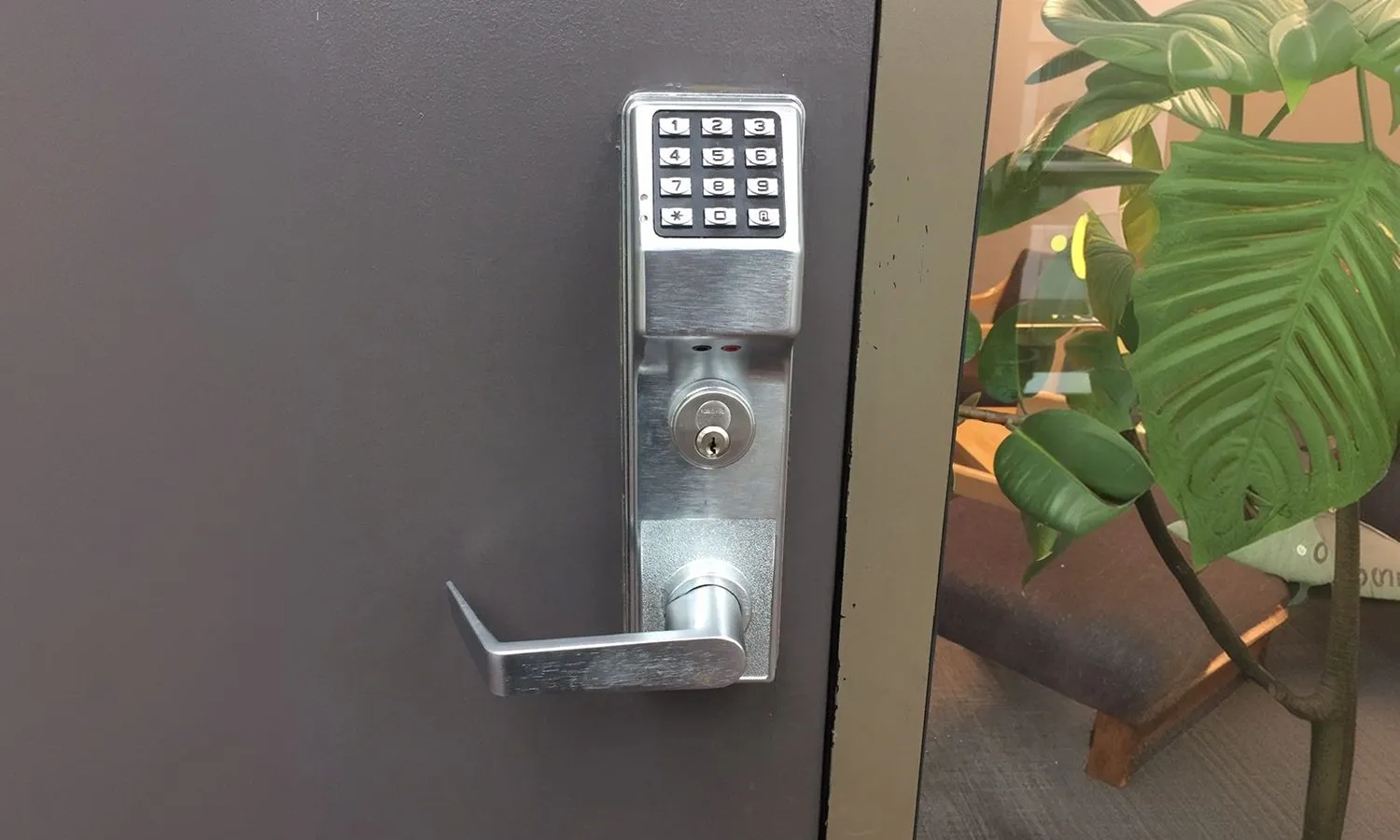
A commercial smart lock changes the credential, not the door. The hardware is still a lock body, a latch or bolt, and a strike it has to land in. Instead of a cut key, the lock reads something you issued: a PIN code, a phone credential, a card. Because a credential is information rather than metal, issuing one or withdrawing it changes what the lock accepts, not how it is pinned.
Scope runs from one opening to several. Our locksmiths look at each opening, main entrances, employee doors, interior offices, and match the lock to the door and frame it has to live in: material, stile width, the prep already cut, how hard the door gets used. A lock built for light duty does not survive an opening that cycles all day.
Electronics in a lock bring a failure mode a key doesn’t have: batteries run down, and somebody has to own the codes. If you want code entry with nothing to power and nothing to administer, that is a mechanical keypad lock, a different product on a different principle. And if the real problem is keys being copied, nothing here fixes it: that is a restricted key system.
Where we do this work
- Offices
- Storefronts
- Restaurants
- Apartment & condo properties
- Warehouses
- Medical facilities
- Multi-tenant buildings
What’s included
-
Credentials you issue and withdraw
PIN codes, phone credentials or cards, given out and taken back without touching the cylinder.
-
Staff changes without chasing keys
Someone’s access ends when you end it, not when the key comes back.
-
Commercial-grade lock hardware
Built for real traffic rather than light duty.
-
Matched opening by opening
Main entrances, employee doors and interior offices are different problems and get different hardware.
-
Door and frame assessed first
Material, stile width, existing prep and alignment decide what will actually fit and keep working.
-
Service after the install
The smart lock gets serviced as a lock, by a locksmith, because that is what it is.
Triggers
When keys stop keeping up
Most people come to smart locks because of how often the answer to "who should get through this door" changes, not because of anything wrong with the lock.
-
You’re cutting a new key every time somebody starts or leaves
The lock is fine; the paperwork around it is the job.
-
Somebody’s access needs to end today
Waiting on a key to come back is not the same as the door being closed to them.
-
A door gets used all day and the lock on it was never built for that
Light-duty hardware on a commercial opening is a short-term lock.
-
You’re replacing hardware on an opening anyway
That is the moment to decide between a key and a code, before anything goes on the door.
FAQ
Smart locks, the questions we actually get.
Don’t see yours? Call (857) 327-1767
What does a commercial smart lock cost?
It depends on the opening and on how many you’re doing, because the hardware grade and the door prep drive the number more than the brand does. A single interior office is a different job from a main entrance with a bolt and a closer on it. You’ll get the scope and the price up front, with no hidden fees.
Is a smart lock as secure as a keyed lock?
Against force, the credential makes no difference at all. What resists a pry bar, a kick or a drill is the lock body, the bolt, the strike and the frame holding it, and those are the same parts whether the door opens to a code or to a key. What changes is the other kind of risk: a key can be copied and never handed back, and a code can be passed along just as easily, so a credential is worth exactly as much as the care taken over who gets one.
Can I still use a key on it?
Often, yes. Many commercial smart locks carry a keyed cylinder as a mechanical override, and on most openings that is worth having rather than designing out. Which hardware offers it varies, so we’ll tell you what the lock you’re considering actually does before it goes on the door.
What happens when the batteries die?
That is the right question to ask about any electronic lock. Battery-powered hardware normally warns you well before it quits, and a mechanical override cylinder is the backstop when nobody acted on the warning. If a door simply must open with nothing powering it, a mechanical keypad lock is the honest answer for that door.
Will it fit the door I already have?
Sometimes directly, sometimes not. Stile width on an aluminum storefront door, the prep already cut into a steel door, and whether the latch and strike line up all decide it. A locksmith looks at the door before recommending a lock, and we’ll say when the door, not the lock, is what needs attention first. Common commercial hardware is usually available and narrow-stile or less common hardware is ordered in, so an opening is either done on the visit or scheduled for when the part is in hand.
Will one of these survive a door that gets used all day?
The right hardware will, and what decides it is the mechanical half rather than the electronics. A reader can work perfectly while the latch, the springs and the lever return underneath it wear out, which is what happens when hardware built for light duty goes on an opening that cycles all day. Traffic also drives battery use, since every opening is a motor running, and it punishes a door that is out of line, so the strike, the alignment and the closer are part of the conversation and not an afterthought.
Can this be done outside business hours?
Yes. We work 24/7 across Boston and the surrounding 30-mile area, so a locksmith can change over an entrance at night or on a weekend instead of while people are trying to use it.
Emergency
Break-in, failed lock, or locked out?
When your property’s security is compromised, our emergency locksmiths respond immediately to repair locks, replace compromised cylinders, and restore reliable operation.
- Commercial Lockouts
- Break-In Lock Repairs
- Emergency Cylinder Replacements
- 24/7 After-Hours Response
Request a quote
Request a quote
Our client services team is standing by to assist with locksmith services, lock changes, high-security hardware, master key systems, lock repairs, rekeying, and emergency security dispatch!
- Hours
- Monday – Sunday: 24/7 Service
- Service area
- Boston and surrounding 30-mile radius
Fully insured by Hiscox
- Google rating
- Verified Screened professionals
- Hiscox Fully insured
- Transparent pricing No hidden fees