
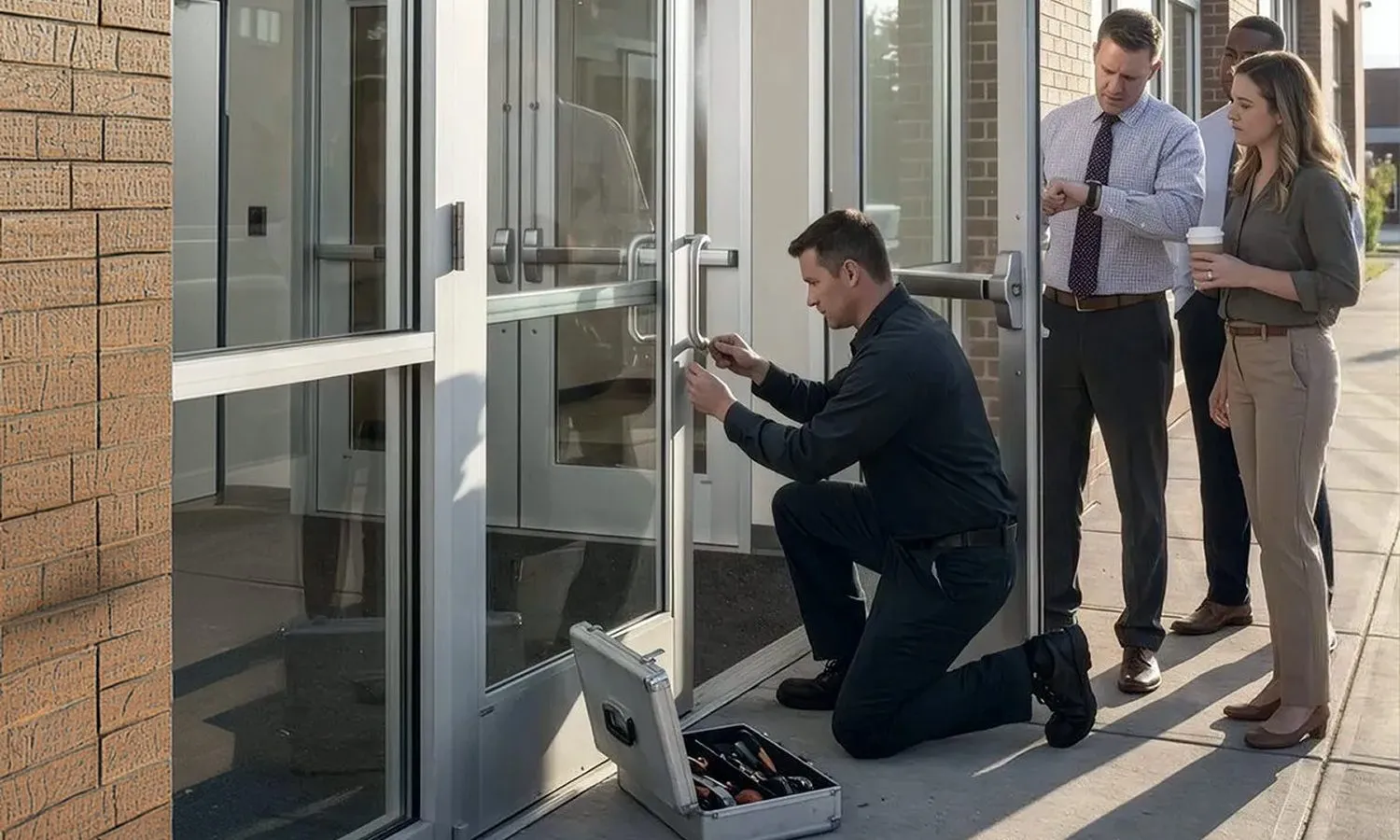




Nothing is broken. That is what makes it a different job.
The back door locked behind someone at four in the afternoon and the key is on a desk on the other side of it. The manager who holds the only stock room key is out until Tuesday. A key went into a pocket on Friday and left the state. Nothing in the building is broken. You cannot get into a room you own. Proving that is where the locksmith’s job starts: we ask for the right to be in a room before touching the lock on it.
That is what makes a lockout different from every other emergency locksmith call: the lock is the thing we are trying to protect, not replace. A cylinder can often be opened by working its pins through the keyway, or the latch reached without touching the lock, and when that works the lock you walk through afterward is the lock you had before. Which method applies depends on the lock and on how long you can wait.
We open locks on exterior entrances, interior offices, storage and stock rooms, employee areas and other secured spaces. A high-security cylinder is a different proposition from a storeroom lever, and some locks will not give up a non-destructive entry quickly enough. Then the honest answer is to drill the cylinder. A drilled cylinder has to be replaced afterward, which is exactly why it is the second option and not the first.
Getting in is not the same as fixing why you could not. A lost key is in circulation, which is a rekeying question, and a lock that failed closed will fail again, which is repair or replacement. If a lock has been forced, that is break-in response. A safe that will not open is its own subject.
Where we do this work
- Offices
- Storefronts
- Restaurants
- Apartment & condo properties
- Warehouses
- Medical facilities
- Multi-tenant buildings
What’s included
-
A key that is lost, not broken
The key is gone, the lock is fine, and the lock still has to open.
-
A lock that has stopped letting you in
The right key is in your hand and the cylinder will not turn for it.
-
Someone shut out of a secured area
Interior offices, stock rooms, storage rooms, employee areas, each behind its own lock.
-
Exterior entrances and interior locks
The front of the building, and the rooms behind it.
-
Entry with as little damage as the lock allows
Non-destructive first; drilling is what a locksmith works to avoid, not what we lead with.
-
A look at the lock once you are back in
Why it happened, and whether rekeying, repair or replacement stops a repeat.
Triggers
When you cannot get in
A lockout is not a hardware problem. It is a lock that works perfectly and a room you cannot reach, and a locksmith is the shortest way back in.
-
The door locked behind you and the key is inside
Back entrances and stock room locks, mostly, and rarely at a convenient hour.
-
A key is lost and there is no spare
Not snapped, not bent: gone, along with any idea of where.
-
The key turns and the lock does nothing
It worked this morning. Now it has failed with the door still locked.
-
The only person with a key is not reachable
Off shift, on leave, or no longer with you, and the lock is still shut.
FAQ
Lockouts, the questions we actually get.
Don’t see yours? Call (857) 327-1767
What does a lockout locksmith call cost?
It depends on the lock, the door, and which method the opening takes, which is why we would rather look at it than name a figure blind. What you get before any work starts is the price for that work, with no hidden fees. If the cylinder has to be drilled, the replacement is part of that conversation rather than a line you find out about later.
Who will you open a lock for?
Whoever can show the right to be there, which we ask for before the lock is touched. The ordinary forms are a lease or a deed, photo identification that matches the business or the tenancy, or the property manager or owner reached on the phone and confirming that you should be let in. Have one of those ready when the locksmith arrives, because without it we will not open the lock.
Will getting in damage the lock?
What decides that is the lock and the door, not a rule we apply to every call. Non-destructive entry is the first choice and is often possible: a cylinder worked through its keyway, or a latch reached without touching the lock, leaves you with the lock you already had. Where a lock will not give one up, the fallback is drilling the cylinder, and a drilled cylinder means a replacement cylinder afterward. You will be told which of the two situations you are in before anything is cut.
The key snapped off in the lock. Is that the same call?
Yes. A broken key is an extraction: the piece has to come back out of the plug without being driven in deeper or dragging the pins with it, and when that goes cleanly the cylinder is still a working lock afterward. It is worth knowing why it broke, though. Keys fatigue and give way on their own after years of turning, but a key that snapped because the plug was stiff is the lock telling you something, and that part is lock repair rather than a key problem.
Should we try to get the lock open ourselves first?
Checking the other entrances and tracking down whoever still has a key costs nothing, so start there. Past that, the usual attempts are expensive ones: a card worked at a latch bends the latch and scars the frame, prying an aluminum storefront racks the leaf and strains the pivot, and drilling blind at a cylinder destroys a lock that would often have opened without it. A lockout stays a lockout right up until somebody turns it into lock and frame repair.
If the cylinder gets drilled, what happens then?
A drilled cylinder is finished, so it is replaced, and often that means a cylinder swap rather than a new lock body, with the lever, the strike and the door left alone. Common commercial cylinders are usually available; anything unusual, restricted or narrow-stile is ordered in, and the entrance is left as secure as the lock allows until it comes. You will know which of the two it is before anything starts, and the fitting itself is lock repair and replacement work.
Can a locksmith come out at night or on a weekend?
Yes. We work 24/7, Monday to Sunday, across Boston and the surrounding 30-mile area, so a lock that shut at eleven on a Saturday does not have to stay shut until Monday morning.
Emergency
Break-in, failed lock, or locked out?
When your property’s security is compromised, our emergency locksmiths respond immediately to repair locks, replace compromised cylinders, and restore reliable operation.
- Commercial Lockouts
- Break-In Lock Repairs
- Emergency Cylinder Replacements
- 24/7 After-Hours Response
Request a quote
Request a quote
Our client services team is standing by to assist with locksmith services, lock changes, high-security hardware, master key systems, lock repairs, rekeying, and emergency security dispatch!
- Hours
- Monday – Sunday: 24/7 Service
- Service area
- Boston and surrounding 30-mile radius
Fully insured by Hiscox
- Google rating
- Verified Screened professionals
- Hiscox Fully insured
- Transparent pricing No hidden fees