


A bolt that holds, and a strike that holds it.
Most commercial back entrances are held by a latch lock alone. A spring latch rides out of the lock body, hits the bevel on the strike and snaps in behind it. Convenient, and almost nothing else: a latch can be pushed back the way it was pushed in. At closing time the opening is held by half an inch of spring-loaded steel.
A deadbolt lock is the opposite. No spring, no bevel: the bolt is square-faced, it moves only when someone turns a key or thumbturn, and once out nothing pushes it back. Throw length is most of the argument: a short bolt in a soft jamb is the usual failure under a pry bar. The strike matters as much, since a thin plate on short screws comes away with the trim.
Our locksmiths fit deadbolt locks on one opening or across a property, chosen per opening: door material, traffic, and what sits behind it. Single or double cylinder is the choice with a real consequence. A double needs a key on the inside as well, which stops an arm through broken glass and slows anyone leaving. On an exit route, that trade runs the other way.
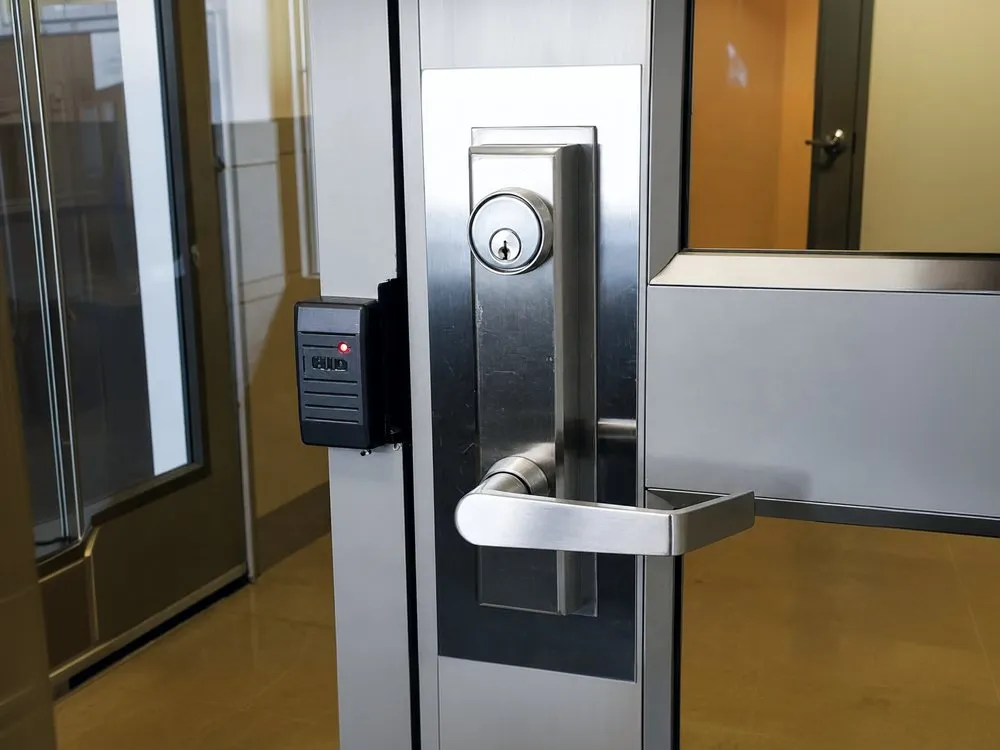
A deadbolt is only as good as what receives it. In a split jamb or a door that no longer closes square, the bolt misses the strike or sits in wood that gives, and the frame is the repair. An aluminum storefront door is its own case: the stile is too narrow for a conventional deadbolt and takes a narrow-stile lock instead. Where the existing lock is worn rather than wrong, repair comes first.
Where we do this work
- Offices
- Storefronts
- Restaurants
- Apartment & condo properties
- Warehouses
- Medical facilities
- Multi-tenant buildings
What’s included
-
New deadbolt lock installs
Fitted to the door it has to hold, with the bore, the backset and the strike set out properly.
-
Hardware chosen per opening
Door material, traffic and the risk behind the opening decide which deadbolt lock goes on it, rather than one default everywhere.
-
Single and double cylinder
The inside of the lock, a cylinder or a thumbturn, decided deliberately, not by whatever was on the shelf.
-
Strike and jamb reinforcement
The receiving side treated as part of the lock, because that is usually where a forced entry gives.
-
Service on deadbolt locks you already have
Bolts that bind, throw short or need the door pulled to turn, put back into proper operation.
-
Keying to the keys you already carry
A new deadbolt lock keyed to the existing key rather than added to the ring.
Triggers
When a latch is the only lock holding the door
A deadbolt lock is usually the locksmith’s answer to one door that closes but does not really lock.
-
The back door only has a latch lock
It clicks shut and feels locked, and a latch is the easiest thing on the opening to defeat.
-
You have to pull the door toward you to get the bolt to turn
The bolt is fighting the strike instead of entering it, and a bolt that throws halfway holds like one.
-
A room needs to be shut properly and the door has no lock on it
Stock rooms, records, server closets, anywhere an interior door was never expected to secure anything.
-
Someone got in through a door that was locked
Pry marks at the jamb, a strike plate on the floor, a bolt that was too short for the gap it had to cross.
FAQ
Deadbolts, the questions we actually get.
Don’t see yours? Call (857) 327-1767
Is adding a deadbolt cheaper than replacing the lock?
Usually, because you keep the lockset that is already working and pay for one more piece of hardware plus the labor to fit it. What moves the number is the door prep: if it is already bored for a deadbolt lock the job is short, and if it is not, the bore, the edge prep and the strike are part of the work. The price is quoted up front, with no hidden fees.
Can a deadbolt go on a door that has never had one?
Usually, yes: a new deadbolt lock needs a bore through the face of the door, a smaller hole through the edge for the bolt, a backset (the distance from that edge to the center of the bore) that matches the hardware, and a pocket and plate cut into the jamb for the bolt to land in. What rules an opening out is what is inside the door: a hollow slab with nothing solid behind the lock area, a stile too narrow to take the bore without weakening what is left, or a jamb that will not hold a strike. We look at the door and the frame before anything is cut, we agree the scope with you first, and we say when the opening wants a different answer rather than a hole in it. Standard commercial deadbolt locks and strikes are hardware the trade generally has on hand, so a straightforward install is usually done on the visit, while anything less common is ordered in and the opening is left as secure as it allows until the permanent work goes on.
Should I get a single or a double cylinder?
It depends on what is next to the door and who has to leave through it. A double cylinder, keyed on both sides, is the usual answer where there is glass within reach of the bolt. On any door people exit through it is the wrong answer, because the key has to be present and in the right hands at the worst moment. We will say which case your lock is, and where the opening is on an exit route, the inside of it is a question for the exit hardware rather than the deadbolt lock.
Can the new deadbolt use the key I already carry?
Often, yes. If the cylinder is compatible with your existing keying, we key it alike so the door adds a lock and not a key. Where the building already runs on a keying plan, the deadbolt lock is keyed into it the same way any other cylinder is.
The deadbolt was locked and the door was forced anyway. What gave way?
Almost always the receiving side rather than the bolt. The common failure is a thin strike plate held by short screws into the jamb trim: a bar levers the plate and a strip of wood out together, and the bolt never had anything to hold onto. The fixes are unglamorous and they work, a strike with a deep pocket, screws long enough to reach the framing behind the jamb, and a bolt with enough throw to sit properly inside that pocket rather than just touching it. Where the jamb itself has split, or the door has dropped far enough that the bolt only half enters, the frame is the repair before new hardware is worth fitting.
My door already has a lock. Do I need a deadbolt as well?
Not always, and we would rather say so than sell one. A sound commercial lockset on a well aligned door in a low-exposure spot may be enough. The case for a deadbolt lock gets strong on exterior and back doors, and any opening where a latch is the only lock between a stock room and the parking lot.
Can you do this outside business hours?
Yes. We work 24/7 across Boston and the surrounding 30-mile area, so a locksmith can fit a deadbolt on a main entrance before opening rather than in the middle of trade, and a door that was forced overnight does not have to stay that way until morning.
Emergency
Break-in, failed lock, or locked out?
When your property’s security is compromised, our emergency locksmiths respond immediately to repair locks, replace compromised cylinders, and restore reliable operation.
- Commercial Lockouts
- Break-In Lock Repairs
- Emergency Cylinder Replacements
- 24/7 After-Hours Response
Request a quote
Request a quote
Our client services team is standing by to assist with locksmith services, lock changes, high-security hardware, master key systems, lock repairs, rekeying, and emergency security dispatch!
- Hours
- Monday – Sunday: 24/7 Service
- Service area
- Boston and surrounding 30-mile radius
Fully insured by Hiscox
- Google rating
- Verified Screened professionals
- Hiscox Fully insured
- Transparent pricing No hidden fees